
Cold Forging: The Manufacturing Process Behind Stronger Rigging Hardware
When two pieces of rigging hardware are both made from 316 stainless steel, why does one hold up better over years of service than another?
The answer often isn't the alloy. It's the manufacturing process.
Cold forging is one of the biggest factors influencing the strength, consistency, and long-term durability of high-quality rigging hardware. While material selection is important, how that material is formed can have a significant impact on mechanical performance.
For rigging shops, boatbuilders, and marine distributors, understanding cold forging helps explain why two parts that look nearly identical can perform very differently over time.
What Is Cold Forging?
Cold forging is a manufacturing process that shapes metal by applying extremely high compressive force at or near room temperature. Instead of melting the metal or heating it to forging temperatures, the material is plastically deformed while remaining solid.
That makes it different from:
- Casting, where molten metal is poured into a mold and allowed to solidify.
- Hot forging, where the material is heated before being formed into shape.
In cold forging, force rather than heat does the work.
How Cold Forging Works
Cold forging typically takes place through several controlled manufacturing stages.
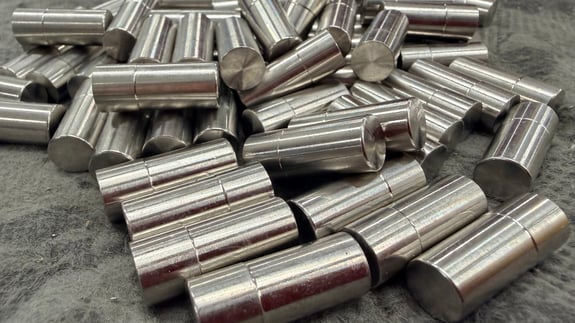
- Material preparation. Stainless steel bar stock is cut into precisely sized blanks.
- Progressive die forming. The blank passes through multiple dies that gradually compress and reshape the material into its near-final geometry.
- Plastic deformation. As the material flows under pressure, the grain structure follows the contours of the finished part rather than being interrupted by machining alone.
- Work hardening. Cold deformation increases hardness and strength through strain hardening while maintaining the alloy's composition.
- Finish machining. Threads, bearing surfaces, and other critical features are machined to their final dimensions and tolerances.
The result is a near-net-shape component requiring minimal material removal while maintaining excellent dimensional consistency.
Why Cold Forging Matters for Marine Rigging Hardware
For standing rigging, manufacturing quality matters just as much as material selection. Cold forging offers several advantages for many rigging components.
Improved Grain Flow
One of the biggest benefits of cold forging is grain flow.
Instead of cutting across the metal's grain structure, the forging process encourages the grain to follow the contours of the part. Proper grain flow can improve toughness and fatigue performance in components subjected to repeated loading.
Excellent Material Integrity
Because the starting material is solid bar stock rather than molten metal, cold-forged components avoid the solidification defects that can occur in castings, such as shrinkage porosity or gas porosity. The forging process also helps consolidate the material during forming.
Better Fatigue Performance
Standing rigging experiences thousands of load cycles throughout its service life from wind, wave action, and normal sailing loads.
Properly designed and manufactured forged components generally provide better fatigue resistance than comparable cast components because of their grain flow and material integrity.
Consistent Dimensions
Cold forging uses precision tooling that produces highly repeatable part geometry. After finish machining, manufacturers can achieve consistent dimensions across production runs, helping fittings assemble and perform as intended.
Efficient Material Use
Because much of the final shape is created during forging, less machining is required than if the entire component were machined from solid stock. This improves manufacturing efficiency while maintaining precise finished dimensions.
Cold Forging vs. Casting
Both manufacturing methods have appropriate applications, but they produce components differently.
Cast parts begin as molten metal that solidifies inside a mold. Modern investment casting can produce excellent components for many marine applications, particularly complex shapes. However, casting quality depends heavily on process control and inspection.
Cold forging starts with solid material and reshapes it under high pressure. For many highly loaded rigging components, this process provides advantages in grain flow, fatigue resistance, and material consistency.
The appropriate manufacturing method ultimately depends on the component's intended application, geometry, loading conditions, and engineering requirements.
How Hayn Uses Cold Forging
Hayn manufactures cold-worked rigging hardware, including turnbuckles, terminals, toggles, and components used in its NAVTEC rod rigging systems.
Rather than relying on cast components, Hayn begins with solid stainless steel and uses cold forging followed by precision machining and finishing to produce critical rigging hardware.
Manufacturing these components in Rocky Hill, Connecticut allows Hayn to oversee the cold forging, machining, finishing, and quality control processes within a single operation. That level of manufacturing control helps deliver consistent dimensions, repeatable quality, and reliable performance from one fitting to the next.
For professional rigging shops, those manufacturing details matter. Hardware isn't judged only by its published breaking strength. Long-term reliability also depends on consistent production, dimensional accuracy, fatigue performance, and confidence that every fitting in the system was manufactured to the same standard.
The Bottom Line
Not all 316 stainless rigging hardware is manufactured the same way.
Cold forging is one of the reasons premium rigging components can deliver greater consistency and long-term durability under demanding marine conditions. By combining solid stainless steel, controlled deformation, precision machining, and rigorous quality control, manufacturers can produce fittings designed to perform reliably through years of cyclic loading.
For professional riggers, the manufacturing process isn't just an interesting detail. It's part of evaluating the quality and long-term performance of every piece of hardware that goes into the rig.