
The Complete Guide to Stainless Steel Turnbuckles
A stainless steel turnbuckle is an adjustable fitting used to tension or adjust a cable, wire rope, or rod. To select one, match the end fittings and thread to the cable and attachment points, verify that the complete assembly is rated for the application, select materials for the exposure, and confirm that the adjustment range and installation method suit the system. In architectural cable railing, the turnbuckle is only one component of a structural load path that also includes the cable, posts, anchors, and supporting construction.
This guide explains the main choices for architectural fabricators, rigging shops, and marine hardware buyers. Always use the manufacturer’s current specifications and installation instructions for the exact assembly being specified.
What is a stainless steel turnbuckle, and how does it work?
A conventional turnbuckle has a body with internal threads and two threaded end fittings. One end is right-hand threaded and the other is left-hand threaded. Rotating the body moves both ends inward or outward, allowing tension to be adjusted without rotating the attached cable. Some cable-rail tensioning systems use related concealed-thread designs and may require rotating the cable during installation; follow the instructions for that specific system.
Turnbuckle assemblies use different end fittings to connect to the surrounding structure or cable:
| End fitting | Connection | Typical considerations |
|---|---|---|
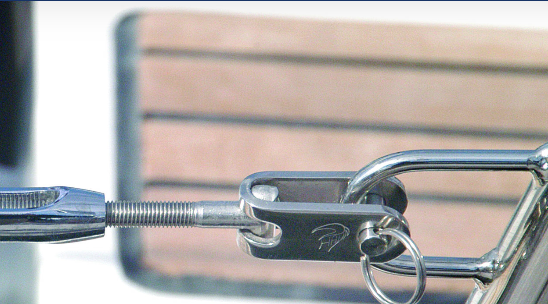
| Toggle jaw | A pin connects the fitting to a compatible eye, bracket, or other attachment point; the toggle articulates at the terminal | Confirm pin diameter, jaw dimensions, and permitted angle for the connection |
| Eye | A closed loop connects to a compatible pin, shackle, or other attachment | Check that the connecting hardware fits and carries the required load |
| Swage terminal | A machine-swaged fitting attaches the wire rope to the turnbuckle assembly | Match the terminal to the wire diameter and construction; use the specified swaging process |
| Termination stud | A threaded terminal passes through or attaches to a post, depending on the system design | Match thread, post, and assembly details to the manufacturer’s system |
| Handy Crimp terminal | A hand-crimped terminal is installed with the specified tool and dies | Hayn specifies its Handy Crimp hardware for low-load lifeline applications only |
A product described as a “stainless steel turnbuckle” may contain more than one material. For example, some assemblies use stainless steel end fittings with a chromed bronze open body. Check the material specification for each component rather than assuming the entire assembly is stainless steel.
What should rigging shops check when selecting a turnbuckle?
Select a turnbuckle by verifying the complete assembly’s rated capacity, matching all connection dimensions, and following the manufacturer’s requirements for material, thread engagement, adjustment, and locking. Check these items before specifying or stocking it:
- Application and load case. Identify whether the fitting is for architectural railing, a lifeline, standing rigging, or another use. Loads, movement, applicable design requirements, and acceptable hardware differ by application.
- Capacity of the complete load path. Check the documented rating and design basis for the turnbuckle assembly, cable, pins, terminals, attachment points, anchors, and supporting structure. The capacity of the system is limited by its weakest component. Do not infer a working load from wire diameter or breaking strength alone.
- Materials and exposure. Specify materials appropriate to the actual environment, including chloride exposure, sheltered locations, dissimilar-metal contact, drainage, and maintenance needs.
- End-fitting compatibility. Match wire diameter and construction, thread size and hand, pin or screw dimensions, and the attachment geometry. Do not mix components unless the manufacturer confirms compatibility.
- Thread engagement and adjustment. Stay within the manufacturer’s minimum engagement and adjustment limits. Do not assume that visible threads alone indicate a defect or that a body can be adjusted to its full open length under load.
- Installation and securing method. Use the specified swaging or hand-crimping process. Secure pins and prevent unwanted body rotation using the method specified for the particular assembly. A cotter or ring pin secures a pin connection; it does not necessarily lock the turnbuckle body.
For Hayn products, check the current product page, catalog, and installation instructions for dimensions, materials, adjustment ranges, run limits, and application restrictions. Hayn states that Handy Crimp fittings are intended for low-load lifeline use and that machine-swaged hardware is required for high-load standing-rigging applications.
Which turnbuckle sizes should a rigging shop stock?
There is no universal stocking list: demand depends on the shop’s customers and the systems it services. For planning, shops commonly review product lines covering wire sizes such as 1/8", 3/16", 1/4", 5/16", and 3/8", then stock only the combinations supported by their manufacturers and customer demand.
| Wire size examples | Potential applications | Stocking checks |
|---|---|---|
| 1/8" | Some light cable railing and lifeline systems | Confirm the application rating and whether the terminal is machine-swaged or hand-crimped |
| 3/16" | Cable railing, lifeline, and selected rigging applications | Match cable construction, thread, pin or screw dimensions, and terminal type |
| 1/4" | Some architectural cable systems and rigging applications | Verify the system’s cable size, assembly rating, and compatible end fittings |
| 5/16"–3/8" | Selected larger cable and rigging systems | Confirm exact product availability and dimensions from the current manufacturer’s table |
These are examples of wire sizes, not a recommendation that a given size is suitable for a particular load. Keep compatible terminals and bodies together by product series and part number. Wire construction also matters: 1×19 is commonly used in architectural railing systems, while more flexible constructions such as 7×7 and 7×19 are used in some marine applications. The product manufacturer must approve the fitting for the chosen cable construction.
Which turnbuckles work in architectural cable railings?
For architectural cable railing, choose a system-compatible tensioning assembly based on the post construction, attachment geometry, cable layout, desired appearance, and adjustment method. Common approaches include:
- Concealed-thread or concealed-tensioner systems place much of the tensioning hardware within or behind the post. Some designs require cable rotation and both left-hand and right-hand threaded components. Run length, adjustment range, and intermediate tensioning requirements are system-specific. For example, Hayn publishes a 40-foot maximum span without intermediate tensioning for its Architectural Tensioner Fork System; that limit does not apply to every concealed-thread system.
- Termination-stud systems use a threaded cable terminal and a post-side tensioning arrangement defined by the product design. Confirm how the system is installed and adjusted; product names and configurations vary.
- Toggle-jaw systems connect by a pin or screw to a compatible structural attachment and provide articulation at the terminal. Confirm the allowable angle and all pin, screw, bracket, and substrate dimensions.
- Deck-toggle and wood-post systems use surface-mounted or lag-mounted fittings designed for those substrates. Follow the manufacturer’s requirements for blocking, fastener embedment, edge distance, and the wood or framing connection. The fitting’s strength does not establish the capacity of the wood connection.
A cable railing must be evaluated as a complete system. Cable pretension creates forces at the end posts, anchors, fittings, and supporting structure. Post stiffness and deflection can also affect cable spacing and opening geometry. The required guard loads and allowable openings are governed by the applicable project code and design; there is no single cable tension appropriate for every railing. Hayn offers architectural cable railing specification information, including CSI-format material, for its listed systems.
How do fabricators choose turnbuckles for exposed exterior cable runs?
For an exposed exterior cable run, select hardware and materials for the site conditions, use fittings that keep forces within their intended alignment, and verify that the complete assembly and supporting structure meet the project requirements. Consider:
- Exposure. Assess chloride or salt spray, de-icing salts, pool chemicals, industrial pollutants, sheltered crevices, drainage, and cleaning access. Alloy choice is important, but detailing and maintenance also affect corrosion performance.
- Run length and system limits. Follow the manufacturer’s maximum run length, adjustment range, and intermediate-tensioning requirements. Cable movement and settling may change tension, but do not use adjustment range as a substitute for a properly designed system.
- Connection alignment. Use articulating fittings where the connection geometry requires them. Do not side-load a fitting that is intended for an in-line pull; confirm allowed articulation with the manufacturer.
- Anchorage and substrate. Verify the capacity of the post, bracket, fasteners, anchors, and supporting construction as part of the full load path.
- Inspection and access. Make sure required inspection points and adjustment features remain accessible after installation. Use the manufacturer’s method to secure the assembly against unwanted movement.
Tensioned trellises also require product and support selection suited to their intended loads. Plant growth, wind, and attachment details can add loads; do not assume a trellis is structurally insignificant because its cable is small.
How should marine buyers evaluate turnbuckles?
Marine buyers should select turnbuckles for the specific rigging application, documented capacity, connection geometry, material exposure, and manufacturer’s inspection and locking requirements. Offshore and standing-rigging service can involve repeated and dynamic loading, so do not select hardware based only on nominal wire size or a general safety margin.
Check the following:
- Application rating. Confirm the manufacturer approves the exact assembly for the intended service and provides the relevant load information. A fitting intended for a lifeline or architectural railing is not automatically suitable for standing rigging or lifting.
- Alignment and articulation. Confirm that toggle or other articulating ends accommodate the connection geometry without unintended side loading.
- Materials and thread compatibility. Some turnbuckle designs combine stainless steel and bronze components. Use only the specified combinations and manufacturer-approved lubricants or anti-seize products; stainless threads can gall if assembled or adjusted improperly.
- Securing and inspection. Use the specified method to secure the assembly. Inspect for cracking, deformation, corrosion, wear, damaged threads, or changes in adjustment, following the manufacturer’s maintenance guidance.
- System-level design. Verify the connected wire, terminals, pins, chainplates or other attachments, and supporting structure for the actual loading and use.
Hayn’s product range includes different open-body, closed-body, toggle-jaw, and lifeline configurations. Material, rating, geometry, and permitted use vary by product; check the exact product specification before selection.
Why choose 316 stainless? 304 vs. 316 for turnbuckles
Type 316 stainless steel generally provides better resistance to chloride corrosion than Type 304 because it contains molybdenum. That makes 316 a common choice for marine, coastal, pool, and other chloride-exposed environments. It does not guarantee a stain-free or corrosion-free installation.
| Consideration | Type 304 stainless | Type 316 stainless |
|---|---|---|
| Relative chloride resistance | Lower than 316 | Generally higher because it contains molybdenum |
| Typical environment | Indoor or less corrosive settings, subject to project requirements | Marine, coastal, pool, or other chloride-exposed settings, subject to project requirements |
| Cost | Often lower | Often higher |
| Corrosion considerations | Performance depends on exposure and detailing | Still vulnerable to unsuitable detailing, deposits, crevices, contamination, and severe exposure |
Corrosion performance depends on more than alloy grade. Salt deposits, poor drainage, crevices, sheltered surfaces, contamination from carbon-steel fabrication, and dissimilar-metal contact can contribute to staining or localized corrosion. In severe chloride exposure, evaluate the site and full assembly with the design professional or manufacturer. Follow appropriate cleaning and maintenance guidance.
How do you install and tension a stainless steel turnbuckle?
Installation procedures vary by product and application. Use the manufacturer’s instructions for the exact cable, turnbuckle, terminal, and connection. In general:
- Check the assembly and instructions. Confirm the parts, thread direction, cable compatibility, adjustment range, and permitted application before installation.
- Install terminals as specified. Machine-swaged fittings require the specified equipment and procedure. Hand-crimp fittings require the specified tool, dies, cable, and application limits.
- Thread and assemble evenly. Hayn’s prefabricated cable assembly instructions direct installers to thread both ends evenly into the body while assembling that product.
- Tension to the system requirement. Hayn’s instructions for installing its prefabricated cable assemblies specify tensioning to no more than 20% of the cable’s breaking strength for that procedure. This is not a universal target for all cable railings or marine rigging. For architectural railing, follow the system instructions and structural design; pretension affects posts, anchors, and supporting construction.
- Secure and inspect. Apply the locking or securing method specified for the assembly, then inspect the completed connections and confirm the system meets its installation requirements.
- Recheck when required. Retension or inspect only as directed by the manufacturer and project maintenance plan.
Stainless steel turnbuckle selection cheat sheet
| If you need… | Evaluate… |
|---|---|
| A less visible railing termination | A concealed system listed for the post type, run length, and adjustment method |
| A tensioner connected through or at a post | The exact termination-stud assembly and its installation details |
| A pivoting connection | A compatible toggle-jaw fitting with verified pin or screw dimensions and permitted articulation |
| A permanent cable terminal | A wire-size- and construction-matched swage assembly installed with the specified process |
| A visual view of thread engagement | An open-body design, while still observing manufacturer engagement limits |
| A streamlined appearance | A closed-body design, if its material, rating, and adjustment range suit the application |
| Chloride exposure | An assembly with materials suitable for the site, plus suitable detailing, cleaning, and maintenance |
| A hand-installed terminal | A manufacturer-approved hand-crimp system used only within its stated application limits |
Frequently asked questions
What is a stainless steel turnbuckle used for?
A turnbuckle adjusts tension in a cable, wire rope, or rod. Applications include architectural cable railing, lifelines, tensioned trellises, and marine rigging, provided the particular assembly is rated and approved for that use.
How do I choose the right turnbuckle size for wire rope?
Match the fitting to the wire diameter and construction, thread size and hand, and attachment dimensions. Then verify the complete assembly’s rating and permitted application with the manufacturer. Wire diameter by itself does not establish a safe load.
Are 316 stainless turnbuckles worth the extra cost over 304?
Type 316 generally resists chloride corrosion better than Type 304, so it is commonly selected for marine, coastal, pool, and de-icing salt exposure. The right choice depends on the actual site, assembly materials, detailing, and maintenance plan. Type 316 does not eliminate corrosion risk.
What is the difference between an open-body and a closed-body turnbuckle?
An open body leaves more of the threaded ends visible, while a closed or tubular body encloses them for a different appearance and configuration. Either type must be installed within its manufacturer’s thread-engagement and adjustment limits.
How tight should cable railing be tensioned?
Follow the specific railing manufacturer’s instructions and the project’s structural design. Hayn’s prefabricated cable assembly instructions set a limit of no more than 20% of cable breaking strength for that installation procedure. It is not a universal tension target for every cable railing; pretension loads the posts, anchors, and supporting structure.
What causes turnbuckle threads to seize?
Stainless threads can gall or seize, particularly if they are forced, poorly aligned, or adjusted without following the manufacturer’s procedure. Use only manufacturer-approved lubricants or anti-seize products and compatible components.
Can I use Handy Crimp fittings for structural loads?
Do not assume so. Hayn specifies Handy Crimp hardware for low-load lifeline applications and says it is not suitable for high-load standing rigging, for which machine-swaged hardware is required. Confirm the intended application and limits for the exact fitting.
Find the right stainless steel turnbuckle
Hayn manufactures marine and architectural rigging hardware, including turnbuckle assemblies and cable railing components. Compare the current product specifications, installation instructions, and application limits to your project before choosing an assembly. Browse turnbuckles, end fittings, and cable railing systems at Hayn.com/lines.
COMMENTS