
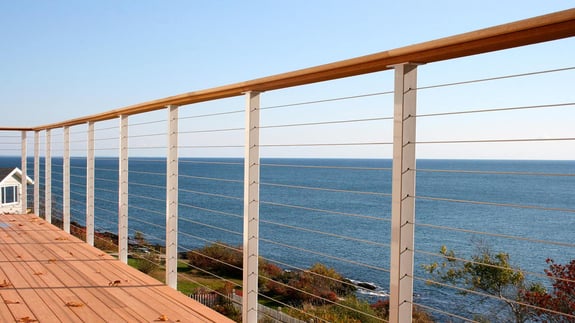
Which Cable Railing Systems Offer Fully Concealed Hardware Options?
Short answer: Cable railing systems marketed as having concealed hardware generally hide the tensioning components inside the post, so the turnbuckles, threaded studs, and swaged terminals that are commonly visible on traditional cable railing systems never project beyond the post. Hayn Lines' Concealed Thread Cable Rail System is one example, built as a through-post application that conceals the adjustment threads internally. The right choice depends on your post material, cable run length, and whether the railing is level or on a stair.
What Does "Fully Concealed" Actually Mean?
Here's the honest answer: "Fully concealed" is a marketing term rather than an industry-standard definition. In nearly every cable railing system, something is still visible at the face of the post. It might be a small head, cap, or finished fitting. What "concealed" really means is that the bulky components, including turnbuckles, threaded studs, and swaged terminals that are commonly visible on traditional systems, are hidden inside the post.
That's why it helps to ask two separate questions:
- Where do the tensioning threads live?
- What does the finished post face look like?
A system can perform well in one area and differently in the other.
Which Cable Railing Systems Have No Visible Turnbuckles?
Cable railing systems that use concealed-thread through-post tensioning eliminate exposed turnbuckles by placing the adjustment mechanism inside the post. While a small finished fitting or cap may still be visible on the face of the post, the traditional external turnbuckle is hidden from view.
For architects, fabricators, and homeowners looking for a clean, uninterrupted appearance, concealed-thread systems are typically the closest option to a truly hidden cable railing installation.
The Main Approaches to Concealed Cable Railing Hardware
| Approach | How it conceals the hardware | Best suited for |
|---|---|---|
| Concealed-thread, through-post tensioning | The cable passes through the post while the adjustment threads remain hidden inside | Level runs and stairs using angle-compensating hardware |
| Receiver-style fittings | A receiver and stud assembly sits inside the post, leaving only a small finished fitting visible on the post face | Projects where a clean exterior appearance is important |
| Proprietary pre-drilled post systems | Posts are manufactured specifically to accept matching concealed hardware | Projects using a complete railing system from one manufacturer |
| Surface-mounted fittings with covers | Tensioning components are enclosed behind decorative covers mounted to the post | Wood-post retrofits and renovation projects |
Each approach offers different tradeoffs between appearance, installation flexibility, cost, and future maintenance.
Hayn Lines Concealed Thread Cable Rail System
Hayn Lines' Concealed Thread Cable Rail System is built around a simple idea: keep the adjustment threads out of sight. It gives cable railings a clean appearance by concealing the tensioning mechanism inside the post while maintaining full cable adjustability. The system is engineered as a through-post application, allowing the cable to pass through the post while tension adjustments remain internal.
Key specifications include:
- Typical straight cable runs of up to approximately 40 feet using 1/8-inch through 1/4-inch cable, depending on project conditions.
- Manufactured from Type 316 stainless steel for corrosion resistance in demanding environments.
- Using adjustable stud tensioners at both ends can approximately double the practical run length compared with a single-tensioner configuration.
- Stair applications are accommodated using bevel washers or Hayn's Adjust-A-Ball hardware.
- Longer railing layouts may be divided into multiple tensioned sections using intermediate turnbuckle assemblies.
- Available with three termination options: machine swage, Hayn Grip (a field-installable compression terminal), and Handy Crimp.
Hayn manufactures its architectural hardware in its U.S. facility using domestic materials, supporting projects that value American manufacturing and consistent product quality.
How to Choose the Right Concealed Cable Railing System
Check Your Post Material First
Not every concealed system works with every post. Some are designed specifically for stainless steel or aluminum posts, while others are compatible with wood, composite, or custom fabricated metal posts.
Measure Your Longest Cable Run
Concealed systems have practical run-length limits that depend on cable diameter, cable tension, intermediate supports, and end-fitting configuration. Knowing your longest span early helps narrow your options.
Plan Stair Sections Early
Stair runs require angle-compensating hardware. Components such as bevel washers or adjustable ball fittings maintain proper cable alignment while allowing accurate tensioning.
Decide How Clean You Want the Post Face to Look
Most concealed systems still leave a small finished fitting visible. Review product photos before specifying a system so the finished appearance matches your design expectations.
Verify Materials and Manufacturing
For exterior projects, Type 316 stainless steel offers superior corrosion resistance. If your project has domestic sourcing requirements, verify where the hardware is manufactured.
Verify Code Compliance
Always verify compliance with the applicable building code and your local Authority Having Jurisdiction (AHJ). Requirements may include guard height, cable spacing, structural loading, and overall guard performance, depending on the project type and location.
Frequently Asked Questions
Can cable railing hardware be completely hidden?
Mostly. The tensioning hardware can usually be concealed inside the post, but a small finished fitting, head, or cap typically remains visible on the face of the post.
Does concealed hardware work on stairs?
Yes. Stair applications use angle-compensating components such as bevel washers or Adjust-A-Ball hardware so the cable can follow the stair angle while remaining properly tensioned.
How long can a concealed cable railing run be?
It depends on the system, cable diameter, support spacing, and end-fitting configuration. For Hayn Lines' Concealed Thread system, typical applications are up to approximately 40 feet, and using adjustable tensioners on both ends can approximately double the practical run length.
What cable sizes work with the Hayn Concealed Thread system?
Typical applications use 1/8-inch through 1/4-inch cable.
Is concealed cable railing harder to install?
Not necessarily, but it requires careful planning. Through-post systems require accurately drilled holes, properly aligned cable paths, and thoughtful layout before installation. Because the adjustment hardware operates inside the post, there is less tolerance for drilling errors than with exposed hardware.
Explore Hayn Lines Cable Railing Systems
If your goal is a clean, modern cable railing with minimal visible hardware, a concealed-thread system is an excellent place to start. Hayn Lines manufactures both Concealed Thread and Traditional Cable Rail Systems in the United States, giving architects, fabricators, contractors, and distributors options for a wide range of residential and commercial applications.
Explore the complete Hayn Lines architectural cable railing product lineup at https://hayn.com/lines.
COMMENTS