
Green Wall Hardware: How Stainless Steel Cable Trellis Systems Support Living Walls
A green wall needs more than plants and irrigation. It needs a support framework strong enough to carry mature vegetation, durable enough for long-term outdoor exposure, and precise enough to hold the pattern an architect designed. The trellis hardware behind that framework plays a major role in how reliably the system performs over its service life.
What is green wall trellis hardware?
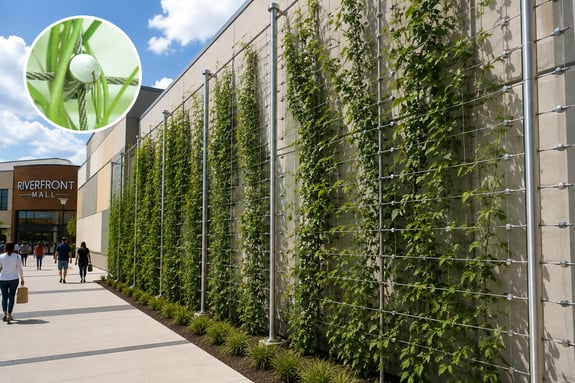
Green wall trellis hardware uses tensioned stainless steel cables, posts, clamps, and mounting components to create a framework for climbing plants. Instead of relying on plants to attach directly to a building facade, the system holds vegetation away from the wall, helping maintain separation between plant growth and the building surface while allowing airflow and maintenance access.
Hayn's Green Wall Trellis System includes components such as:
- Trellis Posts for cable termination and attachment at end and corner conditions
- Traditional Cross Clamps for perpendicular cable intersections
- Universal Cross Clamps for variable-angle cable intersections
- Mount Screws and related mounting hardware for attaching and tensioning the system
Hayn manufactures the primary Green Wall hardware components from 316 stainless steel.
The trellis itself is only part of the overall load path. Anchors, supporting wall construction, cable terminations, standoff distances, and the building substrate all influence how loads are transferred into the structure.
Why does the cable material matter for a green wall?
Green wall hardware remains exposed to rain, humidity, irrigation, plant moisture, airborne contaminants, and, in some locations, coastal chlorides. That makes corrosion resistance a major design consideration.
Grade 316 stainless steel contains molybdenum, which improves resistance to chloride-induced corrosion compared with many commonly used stainless alloys. This makes it well suited to exterior, high-moisture, and many coastal architectural applications.
Hayn's experience with stainless steel rigging dates to 1950, and the same understanding of corrosion-resistant materials used in marine applications carries over to exposed architectural systems.
That does not mean 316 stainless is corrosion-proof. Poor detailing, trapped moisture, aggressive chloride exposure, crevices, and insufficient maintenance can still lead to staining, pitting, or localized corrosion. Proper material selection and detailing remain important, particularly near the coast.
Alternative materials such as galvanized steel, aluminum, coated wire, and polymer-jacketed cable can also perform successfully when properly specified. Each, however, comes with different corrosion, maintenance, wear, structural, and aesthetic characteristics. For exposed architectural systems where long-term appearance and corrosion resistance matter, 316 stainless steel provides a particularly robust option.
What cable sizes does the system support?
Hayn offers Green Wall hardware for 1/8", 5/32", 3/16", and 1/4" wire.
Larger-wire configurations use wider-support-base post options intended to provide additional stability at the mounting point. Final post and cable selection should follow Hayn's current component specifications and the requirements of the individual project.
Cable diameter alone does not determine system capacity. Designers must also consider cable pretension, vegetation weight, water retained by foliage, wind loads on mature plant growth, snow or ice where applicable, standoff distance, anchor geometry, and the capacity of the supporting structure.
Final cable tension, anchorage, attachment details, and substrate requirements should therefore be determined for the specific installation.
How does the system create custom patterns?
This is where trellis hardware differs from a conventional cable railing system.
Traditional cross clamps are designed for perpendicular cable intersections, making them well suited to regular grids. Universal cross clamps allow cables to intersect at variable angles, giving architects greater freedom to develop diagonal, irregular, or custom geometric patterns.
Designers can vary cable spacing, orientation, and grid density based on both architectural intent and the growth characteristics of the selected plant species. A denser grid can provide more frequent attachment points for vegetation, while a wider layout can preserve more visibility of the facade behind it.
The final arrangement should account for both visual goals and structural loading rather than treating the cable pattern as a purely aesthetic decision.
Where is green wall trellis hardware used?
Stainless steel cable trellis systems can support vertical greening in a wide range of architectural applications, including:
- Building facades
- Courtyards
- Parking structures
- Outdoor plazas and public spaces
- Privacy and visual screening
- Landscape walls and freestanding structures
- Architectural features where controlled climbing vegetation is part of the design
Vegetation may also contribute to localized shading, privacy, acoustic, or wind-control objectives, but those performance characteristics depend on plant density, species, geometry, and project conditions. The cable trellis itself should not be treated as a rated acoustic barrier or windscreen.
What should architects consider when specifying a green wall system?
A cable trellis may look lightweight, but the forces involved can become significant once the system is tensioned and vegetation matures.
Design considerations can include:
- Cable pretension
- Mature vegetation weight
- Wind pressure on foliage
- Rainwater retained by plant material
- Snow and ice loads where applicable
- Anchor spacing and geometry
- Standoff distance from the facade
- Supporting wall or structural capacity
- Corrosion exposure
- Drainage and waterproofing around penetrations
- Access for plant maintenance and hardware inspection
Freeze-thaw exposure should also be considered when detailing anchors, concrete or masonry substrates, sealants, penetrations, and areas where water could become trapped.
Because these conditions vary substantially from one building to another, cable tension, anchorage, and attachment details should be coordinated with the project's architect, structural engineer, or other responsible design professional.
Why specify Hayn hardware for green walls?
Hayn's architectural hardware draws on the company's long experience in stainless steel rigging and precision manufacturing. Its Green Wall components are manufactured in the United States at Hayn's Rocky Hill, Connecticut facility, and Hayn states that its hardware is manufactured in accordance with Buy American Act requirements.
For architects, engineers, and fabricators, the value is not simply the appearance of stainless steel. It is the combination of corrosion-resistant material, purpose-built hardware, published cable properties, component specifications, and technical documentation that can be incorporated into a professionally designed facade system.
Hayn also provides CSI 3-part specifications and other architectural resources to assist design professionals with product selection and specification.
Get Green Wall Hardware Specs
Hayn's Green Wall Trellis System includes posts, traditional and universal cross clamps, mounting components, and compatible stainless steel cable for architectural planting systems.
Complete product information, component specifications, cable data, and CSI 3-part specifications are available at Hayn.com.
COMMENTS