
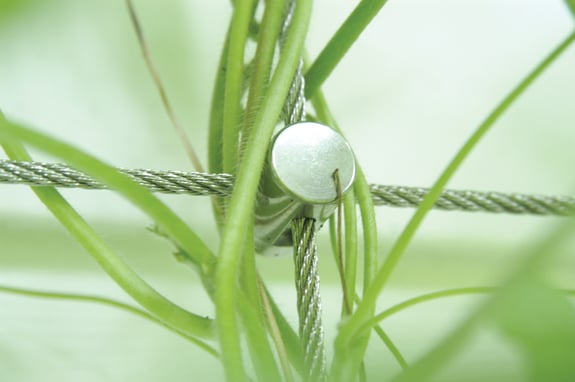
What Is the Best Stainless Turnbuckle Design for Tensioned Trellis Systems?
Trellis systems rely on consistent, adjustable tension to keep cable runs straight, distribute plant growth, and limit sag as vegetation matures. The turnbuckle provides that adjustment, but not every design is appropriate for every installation.
For architects, fabricators, landscape contractors, and distributors specifying hardware for architectural trellis and green-wall projects, the right choice depends on the complete load path, connection geometry, corrosion exposure, adjustment range, and long-term access for inspection.
Start With the Connection Geometry
Turnbuckle end fittings should match both the cable terminal and the structural anchor. The objective is to keep the load aligned through the assembly while allowing any necessary articulation.
Common configurations include:
- Jaw-and-jaw: Useful where the turnbuckle connects to clevis-style or forked anchor points at both ends.
- Eye-and-eye: Suitable for pinned or shackle connections where both anchor points provide compatible bolted attachments.
- Eye-and-jaw or eye-and-toggle: Useful where one end requires a fixed bolted connection and the other needs additional articulation.
- Fork or swage-terminal systems: Designed to connect directly to compatible cable terminals and architectural mounting hardware.
An eye-and-eye or jaw-and-jaw configuration is not automatically better than the alternatives. The correct choice depends on the cable termination, pin or bolt arrangement, and whether the connection must accommodate angular movement.
Articulating jaws, toggles, and forks can help reduce bending and side loading at the connection. However, the turnbuckle still needs to remain substantially aligned with the cable’s load path. Turnbuckles are designed primarily for in-line tension, not for lifting or off-axis loading. DCL Mooring & Rigging
It is also important to distinguish between an eye fitting and a cable terminal. A conventional eye does not automatically connect to a swaged cable. The terminal must be compatible with the turnbuckle, such as a fork, eye, threaded stud, or toggle connection.
Be Careful With Hook Ends
Hook-end turnbuckles may be convenient for temporary or easily captured connections, but they should not be the default choice for a permanent architectural trellis.
An open hook can disengage if the connection becomes unloaded, shifts position, or experiences lateral movement. If a hook is used, it should be positively secured against disengagement and specifically approved by the manufacturer for the application.
For permanent trellis systems, a pinned jaw, eye, fork, or toggle connection is generally easier to secure and inspect.
Open Body or Closed Body?
Open-body turnbuckles leave the threads exposed. That makes it easier to inspect the assembly, clean the threads, and verify how much adjustment remains. They can be useful where regular inspection and service access are more important than a concealed appearance.
Closed-body turnbuckles conceal the threaded mechanism inside a tubular body. They often provide a cleaner architectural appearance and can reduce direct exposure of the threads to rain, irrigation spray, and airborne contaminants.
Neither design is automatically superior in every trellis application.
A closed-body turnbuckle may be a good choice when:
- The hardware is highly visible
- The surrounding design favors a clean, concealed appearance
- The body can drain properly
- The assembly remains accessible for inspection and cleaning
- The manufacturer provides clear installation and adjustment requirements
An open-body design may be preferable when:
- Thread engagement must be visually confirmed
- The system requires frequent adjustment
- Fertilizer, plant debris, or irrigation residue may accumulate
- Maintenance personnel need direct access to the threads
- The hardware is installed in a location where appearance is less important
Hayn describes its closed tubular body as protecting the threaded mechanism from the marine environment, but that benefit still depends on proper detailing, drainage, maintenance, and access. Hayn eye-toggle-jaw closed-body turnbuckle
Type 316 Stainless Steel Is Often the Preferred Baseline
Trellis systems may be exposed to rain, irrigation, fertilizer residue, humidity, plant moisture, airborne contaminants, and coastal chlorides. Those conditions make corrosion resistance an important design consideration.
Type 316 stainless steel is often the preferred baseline for exposed trellis systems, particularly in:
- Coastal locations
- Humid climates
- Heavily irrigated landscapes
- Green-wall installations
- Locations where fertilizer or chemical exposure is expected
- Projects where long-term appearance is especially important
The molybdenum in Type 316 generally improves resistance to chloride-induced corrosion compared with Type 304. However, 316 stainless is not corrosion-proof. Trapped moisture, crevices, surface contamination, poor drainage, and aggressive chemical exposure can still cause staining, pitting, or localized corrosion.
Type 304 may be suitable for some inland installations with less aggressive exposure and an appropriate maintenance plan. Material selection should be based on the actual site conditions, expected service life, appearance requirements, and manufacturer recommendations.
Hayn identifies Type 316 stainless steel as the primary material for its green-wall hardware and notes that cable size alone does not determine system capacity. Hayn green-wall hardware guidance
Specify the Adjustment Range From the Actual Installation
Trellis cables may require adjustment after installation as the cable settles, temperatures change, anchors move slightly, or vegetation adds weight and wind exposure. However, the required adjustment range cannot be determined by a universal rule such as “one full re-tensioning cycle.”
The appropriate range depends on:
- Span length
- Cable construction and diameter
- Initial pretension
- Installation tolerances
- Expected thermal movement
- Anchor movement
- Vegetation weight and growth pattern
- The amount of access available after planting
Specify enough adjustment range to accommodate installation tolerances and anticipated service adjustments while maintaining the manufacturer’s minimum thread engagement and maximum allowable extension.
The turnbuckle should also remain accessible after the plants mature. A component that is technically adjustable but buried behind dense vegetation is not practically serviceable.
For comparison, Hayn lists a 1½-inch adjustment range for its architectural turnbuckle fork system. That is a product-specific specification, not a universal requirement for every trellis system. Hayn architectural turnbuckle fork system
Keep the Entire Load Path in View
The turnbuckle is only one part of the system. The complete load path may include:
- The cable
- Swaged or field-installed cable terminals
- Turnbuckles and connecting pins
- Trellis posts and clamps
- Mounting screws or structural anchors
- The wall, frame, or building substrate
- Waterproofing and penetration details
A trellis may appear lightweight, but mature vegetation can add significant weight. Rain retained by foliage, wind pressure on a mature canopy, snow, ice, cable pretension, and thermal movement may all affect the system.
These loads should be evaluated as combined and potentially variable effects, not simply as a static installation tension. Hayn’s green-wall guidance identifies mature vegetation, retained water, wind, snow and ice, pretension, anchor geometry, standoff distance, and supporting-structure capacity as project-specific considerations. Hayn green-wall hardware guidance
The supporting structure and anchors may govern the design before the turnbuckle does. Cable diameter alone is not enough to establish system capacity.
Select Capacity Using a Consistent Design Basis
Choose the turnbuckle and connected hardware using the applicable project design criteria and the manufacturer’s published capacity data.
The design should confirm adequate capacity for:
- The turnbuckle body
- Threaded components
- Cable and cable terminations
- Pins, bolts, shackles, or clevises
- Trellis posts and clamps
- Anchors and fasteners
- The supporting wall or structural frame
Do not assume that the turnbuckle’s published working load limit represents the capacity of the entire trellis assembly. The system is only as strong as its weakest component or connection.
The engineer or responsible design professional should also confirm the appropriate load combinations and design factors. A published working load limit may already include a manufacturer-defined design factor, so it should not be multiplied again without understanding the basis of the rating.
Design for Inspection and Maintenance
Even a well-specified stainless assembly needs periodic inspection. Maintenance personnel should be able to check for:
- Corrosion, staining, or pitting
- Damaged threads
- Loose pins, nuts, or retaining hardware
- Cable broken wires or abrasion
- Loss of tension
- Deformation at the anchors
- Plant growth interfering with the hardware
- Fertilizer or irrigation residue
- Water trapped inside or around the assembly
The hardware should be detailed so that it can be cleaned, adjusted, and replaced without removing mature vegetation wherever reasonably possible.
The Bottom Line
For many exposed architectural trellis systems, a Type 316 stainless steel turnbuckle with a compatible eye, jaw, fork, or toggle connection can provide the necessary corrosion resistance, adjustability, and appearance.
A closed-body design may be appropriate where concealed threads and a clean architectural finish are priorities. An open-body design may be better where frequent inspection, cleaning, and direct verification of thread engagement are required.
The best selection depends on the cable terminal, anchor geometry, required articulation, exposure conditions, adjustment range, inspection access, and calculated design loads. Keep the assembly aligned with the load path, avoid unsecured hook connections, maintain minimum thread engagement, and make sure the turnbuckle remains accessible after the planting matures.
COMMENTS