
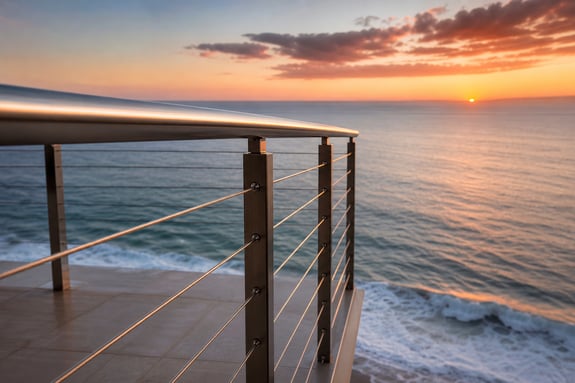
How to Choose Cable Railing for Coastal Homes
Choosing an exterior cable railing system for a coastal home requires more than selecting stainless steel cable. The designer must consider the project’s actual salt exposure, the alloy and finish of the hardware, the compatibility of every material in the assembly, the structural load path, and the system’s ability to be cleaned, inspected, and re-tensioned.
For many coastal residential projects, 316 stainless steel is the preferred starting point because it offers better resistance to chloride-induced pitting than 304 stainless. However, no stainless steel is completely maintenance-free in a marine atmosphere. Surface finish, fabrication quality, drainage, salt accumulation, and cleaning frequency can be just as important as alloy selection.
Why Stainless-Steel Grade Matters
Stainless steel resists corrosion through a thin, self-forming passive oxide film. In coastal environments, airborne chlorides from salt spray and fog can disrupt that film and cause localized pitting or crevice corrosion.
Type 316 stainless contains molybdenum, which gives it better resistance to chloride attack than Type 304. That makes 316 a sound choice for cable, terminals, tensioners, washers, nuts, and other exposed railing hardware in many coastal applications.
Still, 316 stainless can develop tea staining or localized corrosion when salt deposits accumulate, particularly on rough, contaminated, sheltered, or poorly drained surfaces. Projects near breaking surf, saltwater pools, or other severe chloride sources may require additional evaluation rather than assuming that 316 alone will solve every corrosion concern.
Hayn Lines manufactures its Concealed Thread and Traditional Cable Rail hardware from 316-grade stainless steel. The project designer or fabricator should also verify the material, finish, strength, corrosion protection, and drainage details of the posts, rails, anchors, and supporting structure.
Hardware Details That Matter in Coastal Exposure
The most vulnerable locations are often not the open cable spans but the terminations, threaded connections, post penetrations, swages, and concealed crevices where salt and moisture can collect.
Important considerations include:
Compatible materials throughout the load path. Verify the alloy used for cables, terminals, fasteners, washers, and adjustment hardware. Also review any connection between stainless hardware and aluminum, carbon steel, or another dissimilar metal.
Galvanic isolation where necessary. When dissimilar metals are electrically connected in a salt-wet environment, galvanic corrosion can occur. Compatible coatings, nonconductive isolators, sealants, and drainage details may be required, but they must not compromise the strength or stiffness of the connection.
Clean fabrication and finishing. Stainless components should be protected from carbon-steel contamination. Welding heat tint and embedded iron should be removed using appropriate finishing and passivation procedures.
Drainage and crevice control. Sleeves, holes, recesses, and concealed fittings should not trap salt water. Details that drain and dry generally perform better than tight crevices that remain wet.
Serviceable tensioning hardware. Temperature changes, post movement, wood shrinkage, fitting settlement, and repeated loading can change cable tension. The system should permit inspection and re-tensioning without requiring major disassembly.
An exposure-appropriate maintenance plan. Fresh-water cleaning helps remove chloride deposits before they become concentrated. The required frequency depends on distance from the ocean, prevailing winds, rainfall, sheltering, surface finish, and direct salt-spray exposure.
Designing for the View and the Load Path
Cable railing can preserve coastal views, but visual minimalism cannot come at the expense of structural performance.
A properly designed system should:
- Meet the guard-height and opening limitations required by the locally adopted code.
- Account for cable deflection rather than relying only on the unloaded cable spacing.
- Provide posts and end connections capable of resisting accumulated cable-tension forces.
- Transfer guard loads through the posts, base plates, anchors, deck framing, and building structure.
- Address any project-specific wind loads required for the site and guard configuration.
- Provide adequate edge distance, post-wall thickness, and reinforcement around cable penetrations.
- Remain accessible for inspection, cleaning, and adjustment.
Post dimensions should be established by engineering analysis or a tested system. The use of 316 stainless hardware improves corrosion resistance, but it does not justify reducing post or anchor capacity.
What to Ask Before Specifying a System
Before selecting a coastal cable railing system, ask:
- What alloys are used for the cable, terminals, fasteners, washers, and tensioning hardware?
- Is 316 stainless appropriate for the project’s actual marine-exposure severity?
- What surface finish and passivation procedures are used?
- How are dissimilar-metal interfaces isolated and drained?
- Can the cables be inspected and re-tensioned after installation?
- What are the manufacturer’s cable-size, swaging, tensioning, span, and installation requirements?
- Are structural capacities or test data available for the complete proposed assembly?
- Who is responsible for designing the posts, anchors, and supporting structure?
- What cleaning and inspection schedule is recommended?
- Are U.S.-manufactured components available when domestic-content requirements apply?
Why Hayn Lines
Hayn Lines offers Concealed Thread and Traditional Cable Rail hardware manufactured from 316-grade stainless steel. The available attachment options include machine-swaged assemblies and field-installable methods, allowing fabricators to select a termination approach suited to the project and installation conditions.
For coastal projects, the hardware should be incorporated into a complete railing design that accounts for exposure severity, post and anchor capacity, material compatibility, drainage, code-required guard performance, and ongoing maintenance. When those elements are coordinated, 316 stainless cable railing can provide durable performance while preserving the open sightlines coastal properties demand.
COMMENTS